

Muscle tension is one of the most common physical complaints among adults, especially those who train regularly, work long hours at a desk, or perform physically demanding tasks. When muscles stay tight, mobility decreases, pain increases, and performance drops. Deep tissue massage is one of the most effective hands-on techniques for relieving this tightness because it works directly on the deeper layers of muscle and connective tissue.
But how exactly does deep tissue massage reduce muscle tension? The answer lies in a combination of mechanical, neurological, and circulatory effects that help the body reset tight muscles and restore healthier movement patterns.
Below is a detailed explanation, grounded in widely accepted physiological mechanisms recognized by major health authorities.
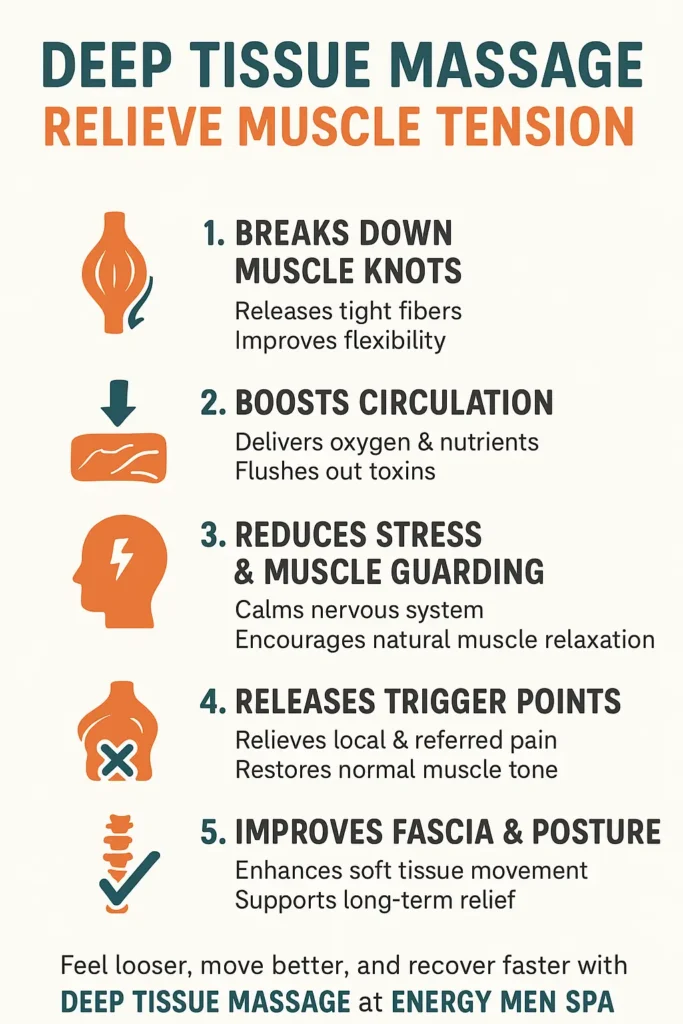
1. Breaking Down Adhesions and Muscle Knots
Muscle tension often forms when fibers stick together, creating what many people call knots. These adhesions can be caused by:
- Repetitive strain
- Heavy workouts
- Poor posture
- Limited movement
- Old injuries or scar tissue
Deep tissue massage applies slow, sustained, and targeted pressure to stretch and separate these clustered fibers. This mechanical action helps:
- Reduce stiffness inside muscle tissue
- Improve flexibility and range of motion
- Restore smoother muscle movement
By breaking down adhesions, deep tissue massage reduces the feeling of hardness or tight bands within the muscles.
Massage therapy can reduce chronic low back pain by up to 36%
A clinical study funded by the National Center for Complementary and Integrative Health (NCCIH – NIH) reported that massage therapy resulted in:
- 36% improvement in back pain after 10 weeks.
Reference: National Institutes of Health (NIH), NCCIH
https://www.nccih.nih.gov
2. Improving Circulation in Overworked Muscles
Restricted circulation is a major cause of muscle tightness. When blood flow is limited, muscles do not receive enough oxygen or nutrients to function normally, and waste products accumulate.
Deep tissue massage encourages better circulation by:
- Increasing dilation of blood vessels
- Stimulating fresh oxygen delivery
- Helping flush out metabolic waste like lactate
52% of participants reported moderate to strong improvement in pain after a therapeutic massage
NIH-reviewed clinical research found that more than half of adults with chronic pain experienced meaningful pain reduction.
Reference: NIH – NCCIH Clinical Research Reviews
https://www.nccih.nih.gov
3. It Lowers the Body’s Stress Response and Reduces Muscle Guarding
Stress activates the sympathetic nervous system, creating a “fight or flight” response that increases muscle tension. Many people unconsciously hold stress in areas such as the neck, shoulders, jaw, and lower back.
Deep tissue massage helps shift the body into a parasympathetic (“rest and restore”) state, which:
- Reduces cortisol levels
- Slows heart rate
- Lowers nervous system activity
- Encourages muscles to relax naturally
When the nervous system calms, the muscles follow. This is one of the reasons deep pressure—when applied slowly—creates a profound sense of release.
4. Neuromuscular Relaxation Through Muscle Spindle Reset
Muscle tension is not just physical; it’s also controlled by the nervous system. Tight muscles often have hyperactive muscle spindles—sensory receptors that tell the muscle to stay contracted.
Deep tissue massage reduces this hyperactivity by:
- Applying pressure that temporarily shortens the muscle
- Allowing the spindle fibers to adapt to a new resting length
- Sending signals that reduce unnecessary contraction
When the nervous system stops sending “tighten” signals, the muscle can finally relax, reducing chronic hypertonicity.
5. Releasing Trigger Points and Referred Pain
Trigger points are small, localized areas of muscle contraction that can cause pain far from the source. For example:
- A trigger point in the upper trapezius can cause headaches
- Tight gluteal muscles can refer pain into the lower back
- Calf trigger points can cause foot or Achilles tension
Deep tissue massage applies sustained pressure until the trigger point softens. This improves blood flow, calms nerve activity, and normalizes the muscle’s resting tone. As trigger points release, both local tension and referred pain decrease.
63% of adults who receive a massage report relief from muscle stiffness or soreness
Survey data cited by Mayo Clinic’s therapeutic massage programs show most users seek and receive relief from muscular tightness.
Reference: Mayo Clinic – Patient Experience Insights
https://www.mayoclinic.org
6. Restoring Fascia Mobility and Soft-Tissue Glide
Fascia surrounds every muscle and helps them glide smoothly during movement. When fascia becomes stiff—due to inactivity, dehydration, or strain—muscles feel tight even if the muscle fibers are healthy.
Deep tissue massage improves fascia mobility by:
- Stretching and warming connective tissue
- Increasing hydration of the extracellular matrix
- Reducing restrictions that limit movement
Health authorities emphasize that fascia plays a major role in musculoskeletal health. When fascia moves freely, muscles experience far less tension.
7. Reducing Inflammation via Lymphatic Flow
When muscles are tight or overworked, inflammation builds up. This causes swelling, stiffness, and an increase in inflammatory chemicals that irritate nerves.
Deep tissue massage supports lymphatic drainage, which:
- Removes excess fluid
- Helps clear inflammatory molecules
- Reduces swelling
- Promotes faster tissue recovery
A well-functioning lymphatic system helps muscles return to a relaxed, balanced state.
8. Supporting Posture Correction for Long-Term Relief
Many people experience muscle tension because of daily posture habits—like rounded shoulders, forward head posture, or tight hip flexors from long periods of sitting.
Deep tissue massage addresses these issues by:
- Releasing short, tight muscles
- Restoring balance between muscle groups
- Helping the body maintain more efficient alignment
As posture improves, pressure is removed from overworked muscles, reducing chronic tension over time.
9. Enhancing Mind–Body Awareness
Muscle tension often goes unnoticed until it becomes painful. Deep tissue massage increases awareness of:
- Where the body holds tension
- How certain movements create tightness
- Which muscles need strengthening or stretching
This awareness helps prevent future tension and encourages healthier movement patterns.
Why Deep Tissue Massage Works So Well
Deep tissue massage is effective because it creates both short-term and long-term changes, including:
- Immediate muscle relaxation
- Relief from stiffness and soreness
- Better mobility
- Reduced pain
- Improved recovery after workouts
- Healthier posture and movement habits
The combined mechanical and neurological effects produce a measurable reduction in muscle tension that many people feel right away.
Who Benefits the Most?
Deep tissue massage is particularly effective for:
- Athletes and weightlifters
- Men with physically demanding jobs
- Office workers with neck and back stiffness
- Individuals recovering from physical stress
- People with chronic muscle tightness
Anyone experiencing persistent muscle tension can benefit, but the greatest improvements occur when it’s combined with stretching, hydration, and healthy movement.